Category Archives: culture
FBI agent leases building to FBI and lies about it…BTW that’s illegal
In 2001, Philip Halbert Neilson was placed as the supervisory agent in charge of locating the building that the FBI would be using in Oxford, MS. Agent Neilson made his recommendation and the FBI moved in and set up shop. Everything is cool to this point. Read the rest of this entry
Pseudo-Reality Shows?
“Pseudo-Reality Show” is a term that I have had to create to class a television show that pretends to be a documentary of some sort as the vehicle that allows the camera to capture the “goings on” in the show itself. This hybrid docu-sitcom thing has made me realize something. I believe that that the veil should not be broken if you need believability in your show. “The Veil” that I am referring to is the barrier that allows the viewer to remain INVISIBLE and UNABLE to interact with the show itself. These newer shows not only pierce said veil they erase the damned thing all together when they have Big Brother diary like sessions that expound on actions and the hilarity of the show. Another thing that these Pseudo-Reality Shows do is look at the camera in a “Did you see that?” kind of way OR a “I am so embarassed” kind of way. Both of wich are very effective in getting me to “share” in the moment. It is a cheap way to get me to like/empathize with the character. If you don’t know what I mean, here is a senario:
(Fade In From Commercial)
(Lead in Music Fades out)
CHARACTER 1 is discussing a topic with CHARACTER 2.
CHARACTER 2 says something that stuns CHARACTER 1.
CHARACTER 2 walks away.
CHARACTER 1 look into camera and blinks.
That’s it.
Did you notice that there is no dialogue in the above example? “Why?” You ask. YOU DON’T NEED IT! The blink by CHARACTER1 and the direct acknowledgment with the look into the camera that YOU experienced that with CHARACTER 1 is all you and the show need to make you, the viewer, relate to the CHARACTER and thereby making you like it.
This seemingly innocent device of making the viewer a cast member does not work on shows where the writing and acting can carry the weight of the plot while building attachment from the audience. LOST will never have a character look into the camera and shrug as a means to say “Hey you in TV LAND, That was zany right?”
New shows to watch that are good who fit into the Pseudo-Reality Category:
Community

Modern Family

Parks and Recreation

Watch em and see what ya think about them looking at you like you are there. I find it great when its done well (MODERN FAMILY) comical when its used as sparingly (COMMUNITY) and annoying when its done every 5 minutes to drive home a lame joke (PARKS AND RECREATION).
I am sure there are more than these 3, but you get the point.
You make the call!
Who’s ya boy in Slovenia???
Breakdown of Obtuse View readers by country!
United States (US) 423
United Kingdom (GB) 21
Canada (CA) 12
India (IN) 6
Germany (DE) 4
Australia (AU) 3
Sweden (SE) 2
New Zealand (NZ) 2
Italy (IT) 2
Norway (NO) 2
Mexico (MX) 2
Austria (AT) 1
Netherlands (NL) 1
Latvia (LV) 1
France (FR) 1
Belgium (BE) 1
Georgia (GE) 1
Vietnam (VN) 1
Sri Lanka (LK) 1
South Africa (ZA) 1
Nepal (NP) 1
Lebanon (LB) 1
Spain (ES) 1
China (CN) 1
Afghanistan (AF) 1
Slovenia (SI) 1
THANK YOU TO ALL THE READERS OF OBTUSE VIEW!!!

Before Obtuse View

- After Obtuse View

My Food Network Wish

If I were granted some wishes from a genie in a bottle one would be to have dinner with 6 Food Network chefs. Not because of their cooking style or food of choice, but because they look and appear on TV to be cool. So, here are my top 6 Food Network chefs that I want to have dinner with. (In no particular order.)
 Alton Brown: Host of Good Eats and all around smart cookie. I think this man is hilarious and wicked smart. I would expect him to say things like, “You know pomegranates were once used for arthritus medicine because of their molypeptidal antioxidant qualities.” (or something like that) He is cool plain and simple.
 Michael Symon: Iron Chef America icon. He wasn’t chosen, he earned his way to Iron Chefdom! I named my dog Symon after this man. Humorous and always polite, I think he and I could talk about “guy” stuff like why Van Halen was better with David Lee Roth and just hot Nigella Lawson really is.
 Guy Fieri: Host of Diners, Drive Ins, and Dives, He and I would just eat things while not caring that we had food on our faces. He bleaches his hair…I will let that pass because he KNOWS where some good grub lives and isn’t afraid to eat it. After eating we would cruise in the ’65 and pimp our way on down the road listening to AC/DC or Jimmy Buffet.
Ted Allen: the host of CHOPPED is hands down one of the funn iest and arguably the smartest man on FN.(NOTE: It’s between Ted and Alton for the Food Geek Crown.) As the host of Chopped he tells punks that don’t include one of the ingredients “Sorry, you don’t get ten thousand dollars and you aren’t the Chopped champion.” He and I would talk about how good a gin and tonic is in the summertime and why Guy Fieri needs to wear long pants in the kitchen.
The Neelys: Hosts of Down Home with the Neelys
I love these people. Being from Memphis, they are in the same geographic mindset I am in. We could talk about Channel 5 news, why the pyramid was a bad idea, and “the spice fairy.” If you have never seen their show, it is the most sexually charged chemistry between a married couple in a kitchen EVER. She will say things like “Rub that meat big daddy!” and it not be too sexual for TV…but you know what she means. He says things to her like “You know I am gonna whip this merangue up, Momma!” It is kinky bedroom talk in the kitchen. AWESOME!
NOTE: If you watch FN, you may notice that they put star anise in everything now days. Don’t do it. Trust me.
I was corrected by the wife after posting on 2 points:
1) Star anise is “UMAMI” enhancing (I still feel it doesn’t go in EVERYTHING)
2) Nigella Lawson is not a “beauty for the ages” but she is “incredibly sexy.” My wife is so right, esp. about Nigella. <growl>
Oh, Glenn…
Beck: ‘African-American is a bogus, PC, made-up term. I mean, that’s not a race.’
By: Ben Armbruster
Today on his radio show, Glenn Beck wanted to discuss the census. “Apparently the census has come out,” he said. Beck’s co-host then chimed in, “Yeah and there’s a little confusion because there’s three boxes you can check if you’re a certain race. … I don’t know what the race is because there’s three different terms for them. Black, African-American, or Negro.” Instead of having any consideration to take issue with the term “Negro,” Beck launched into a tirade against “African-American”:
BECK: African-American is a bogus, PC, made-up term. I mean, that’s not a race. Your ancestry is from Africa and now you live in America. Ok so you were brought over — either your family was brought over through the slave trade or you were born here and your family emigrated here or whatever but that is not a race.
Previously, Beck has said that he doesn’t have “a lot of African-American friends, and I think part of it is because I’m afraid that I would be in an open conversation, and I would say something that somebody would take wrong, and then it would be a nightmare.” And recently on his Fox News program, Beck hosted a group of black conservatives and complained that some of them refer to themselves as “African-American.” “Why not identify yourself as Americans?” he asked, adding, “I don’t identify myself as white, or a white American.”
The Original Posting of this Article is Located HERE
Just when you thought you have seen it all..
I give you this:
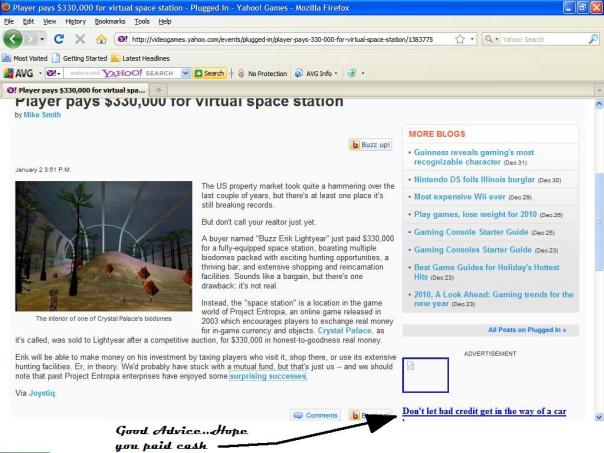
Yeah $330,000 for a "virtual" space station...Shit.
This guy “Buzz Eric Lightyear” (aka Dumbass) paid $330,000 American dollars for a cyber space station. HELLO EVERYONE OUT THERE…It isn’t real. It is a cyber-property in a game called Planet Calypso that encourages people to exchange real money for things in the game. This guy is going to host “hunts” and tax people who shop and visit the things on his space station in hopes to recoup his $330,000 investment. OMFG!!! Why do those with an extra $330k blow it on CYBER SPACE STATIONS and those like me who actually need it will never see $330k all in one bundle.
Fuck, I need a nap.
Wall Street’s 10 Greatest Lies of 2009
On December 13, President Obama declared that he was not elected to help the “fat cats.” But the cats got another version of that memo. A day later, 10 of them were supposed to partake in some White House face-time to talk about their responsibilities to the rest of the country, but only seven could make it. No-shows for the “very serious discussion” — due to inclement New York weather or being too busy with internal bonus discussions to bother with the President — were Goldman Sachs CEO Lloyd Blankfein, Morgan Stanley CEO John Mack and Citigroup Chairman Richard Parsons.
Yes, Obama inherited a big financial mess from the Bush administration – which inherited its set-up from the Clinton administration (financial recklessness, it turns out, is non-partisan) — but he and his appointees have spent the year talking about fighting risk and excess on Wall Street, while both have grown.
Treasury Secretary Tim Geithner patted himself on the back for making the “difficult and necessary” decisions of fronting Wall Street boatloads of money to cover its losses and capital crunch last fall. Federal Reserve Chairman Ben Bernanke (a Bush-Obama favorite) was named Time Magazine’s Person of the Year for saving the free world as we know it. And Congress is talking “sweeping reform” about a bill that leaves the banking landscape intact, save for some minor alterations. For starters, it doesn’t resurrect the Glass-Steagall Act of 1933, which separated risk-taking (once non-government-backed) investment banks from consumer oriented (government-supported) commercial banks.
Meanwhile, Wall Street is restructuring (the financial equivalent of re-gifting) old toxic assets into new ones, finding fresh ways to profit from credit derivatives trading, and paying itself record bonuses — on our dime. Despite recent TARP payback enthusiasm, the industry still floats on trillions of dollars of non-TARP subsidies and certain players wouldn’t even exist today without our help.
Wall Street’s return to robustness and Main Street’s continued deterioration are the main takeaways for 2009 that stemmed from the 2008 choices to flush the financial system with capital and leave the real economy to fend for itself. Lies that exacerbate this divide only perpetuate its growth. With that, here is my top 10 list of lies. Please consider adding your own, and let’s all hope for a more honest New Year.
1) The economy has improved.
Earlier this month, Bernanke declared, “Having faced the most serious financial crisis and the worst recession since the Great Depression, our economy has made important progress during the past year. Although the economic stress faced by many families and businesses remains intense, with job openings scarce and credit still hard to come by, the financial system and the economy have moved back from the brink of collapse.”
Sure, the economy is better — if you work at Goldman Sachs or had an affair with Tiger Woods. But while Bernanke, former Treasury Secretary Hank Paulson and Geithner turned the Federal Reserve into a national hedge fund (cheap money backing toxic assets in secrecy), and the Treasury Department into a bank insurance policy, the rest of the real economy took hit after hit — starting with jobs.
The national unemployment rate remains at double digits. Despite Washington’s bizarre euphoria about unemployment rates last month being better (they edged down in November to 10 percent from 10.2 percent in October), the number of Americans filing for initial unemployment insurance rose during the second week of December. After all the temporary holiday hires, that number will probably increase again. Plus, unemployment rates in 372 metropolitan areas are higher than they were last year.
2) If you give banks capital, they will lend it out.
On Jan. 13, 2009 Bernanke concluded that “More capital injections and guarantees may become necessary to ensure stability and the normalization of credit markets.” He said that “Our economic system is critically dependent on the free flow of credit.” He was referring to the big banks. Not the little people.
Ten months later, though, he admitted that, “Access to credit remains strained for borrowers who are particularly dependent on banks, such as households and small businesses” and that “bank lending has contracted sharply this year.”
In other words, big banks don’t share their good fortunes. Shocking. And as a result, bankruptcies are rapidly rising for businesses and individuals – a direct result of lack of credit coupled with other economic hardships like job losses.
Total bankruptcy filings for the first nine months of 2009 were up 35 percent to 1,100,035 vs. the same period in 2008. The number of business bankruptcies during the first three quarters of 2009 eclipsed all of 2008. Individual consumer filings totaled 373,308 during the third quarter of 2009 and were up 33 percent vs. the same period of 2008. Tell those people about the free flow of credit, Ben.
3) Taxpayers are being repaid.
On December 17, the Treasury Department announced: ”As a result of our efforts under EESA (the Emergency Economic Stabilization Act that spawned TARP), confidence in our financial system has improved, credit is flowing, and the economy is growing. The government is exiting from its emergency financial policies and taxpayers are being repaid.”
Even as banks rush to repay TARP in order to get the government off their backs before annual bonuses are set, the Treasury Department is helping them out. On December 11, the Internal Revenue Service gave government-subsidized banks a tax exemption that, for instance, allows Citigroup to keep the benefit of $38 billion. Three days later, Citigroup announced its $20 billion repayment of TARP. Get the math? Not exactly a taxpayer windfall.
Additionally, the FDIC gave banks including Citigroup, Bank of America, and JPMorgan Chase a holiday gift — at least a six-month break from having to raise capital to support the billions of dollars of securities (read: toxic assets – remember those?) that firms are going to have to add to their books in 2010. That will open a whole new can of worms – a glimpse into either insolvency and a replay from the too-big-to-fail scenario, or book-cooking (the Financial Accounting Standards Board, as of last year, has allowed banks to price their own assets if there’s no true market for them – fun times), or both. Meanwhile, banks can use the capital for bonus payments instead.
4) Homeowners are being helped.
Last year’s big lie was that banks would turn around and help their borrowers if they got federal money. Yet, they were under no obligation to do so, and thus, they didn’t.
Since the Obama administration released guidelines for the Home Affordable Modification Program (HAMP) on March 4, 2009, the HAMP permanent loan modification numbers have been anemic.
Separately, by almost every measure, mortgage and credit problems are worse this year than last. There were almost a million new foreclosure fillings in the third quarter of this year, 5 percent more than in the second quarter, and 23 percent more than during the third quarter of 2008.
Plus, foreclosures are not abating. Mortgage delinquencies (borrower 60 or more days overdue) increased for the 11th quarter in a row, reaching a national average record of 6.25 percent for the third quarter of 2009. Delinquencies precede foreclosures. Compared to last year, mortgage borrower delinquencies are up 58 percent. Meanwhile, banks are sitting on properties they acquired to avoid selling them into the market and having to book the resultant loss.
5) Big banks will help small businesses.
On October 24, because a whole year had passed without this happening, Obama declared, “It’s time for our banks to stand by creditworthy small businesses and make the loans they need to open their doors, grow their operations and create new jobs.”
Small businesses, which employ half of all private sector employees, had received less than $400 million in new loans under government programs, and were granted access to just one program that buys up to $15 billion in securities tied to small business loans. According to the Small Business Administration (SBA) the number of approved loans shrunk from 124,360 in 2007 to 69,764 in 2009 (it was 93,541 in 2008).
Two months later, since that didn’t work, Obama reiterated, “given the difficulty business people are having as lending has declined, and given the exceptional assistance banks received to get them through a difficult time, we expect them to explore every responsible way to help get our economy moving again.” He asked the big bank chiefs to take “extraordinary” steps to revive lending for small businesses and homeowners.
Too bad banks don’t gear their business strategy to expectations and suggestions. Still, as a gesture of good faith, Bank of America promised to kick in an extra $5 billion more to small- and medium-sized businesses next year. JP Morgan Chase promised to increase lending by $4 billion. Goldman had already decided to go the pledge route a few weeks earlier, putting up half a billion dollars in small business “charity” to help its deservedly negative image.
To make up for what the banks aren’t doing, the Obama administration is setting aside $30 billion from the financial bailout fund to stimulate lending to small businesses.
6) The Fed values transparency.
On February 10, Bernanke told the Committee on Financial Services that he “firmly believes that central banks should be as transparent as possible. Likewise, the Federal Reserve is committed to keeping the Congress and the public informed about its lending programs and balance sheet.”
Yet, on March 5, the Fed refused to comply with a Freedom of Information Act request and lawsuit filed by Bloomberg News to disclose the details of its 11 lending facilities. In front of the Senate Budget Committee, and in response to a question from Senator Bernie Sanders, I-VT, about naming the firms that got money from those facilities, Bernanke said “No” — such disclosure would be “counterproductive” and risk “stigmatizing banks.”
Undaunted by this irony, on May 5, before the Joint Economic Committee, Bernanke reiterated, “The Federal Reserve remains committed to transparency and openness and, in particular, to keeping the Congress and the public informed about its lending programs and balance sheet.” He told PBS NewsHour on July 28 that “We are completely open to providing any information Congress wants.”
To date, the Fed has not disclosed the recipients of its cheap loans for toxic collateral.
7) History will not repeat itself.
In the beginning of the year, Obama said of Wall Street firms, “There will be time for them to make profits, and there will be time for them to get bonuses. Now is not that time.”
He also said that “part of what we’re going to need is for the folks on Wall Street who are asking for help to show some restraint and show some discipline and show some sense of responsibility.”
Yeah. Wall Street’s really into restraint….
Nine month later, as banks were racking up record profits and bonuses, Obama said the same thing, in different words, in his September 14 Federal Hall speech. “We will not go back to the days of reckless behavior and unchecked excess at the heart of this crisis, where too many were motivated only by the appetite for quick kills and bloated bonuses… the old ways that led to this crisis cannot stand…History cannot be allowed to repeat itself.”
The only problem? History was repeating itself, as he spoke. Big banks took more risk in 2009, and posted more of their profits from trading operations than they had before they nearly collapsed in 2008. Trading profits at the top five banks rose from a $608 million loss in 2008 to $118.5 billion for annualized 2009, and $61.7 billion in 2007.
8 ) The pay czar will fight against – pay.
Treasury Department pay czar Ken Feinberg was supposedly appointed to keep a lid on excessive compensation for companies sitting on federal bailouts. Two problems with that: first, the Treasury Department continues to ignore the fact that the TARP portion of the bailout was only a tiny portion of the full bailout, and second, Wall Street was pushing back and winning at every turn.
For instance, after announcing he’d cap compensation for the top 25 execs at AIG, on October 23, Feinberg gave three of them a pass. These men were apparently “particularly critical to the company’s long-term financial success.” Turning to his other role as Wall Street’s mouthpiece, Feinberg made excuses for AIG. “AIG compensation practices are unique. We took into account independent, very credible opinions of others to come up with a package that we think will help AIG thrive.” That’s nice.
But he’s not kidding about thriving – those three employees will receive bonuses of about $4 million, $5 million and $7 million. AIG’s new CEO, Robert Benmosche, who joined AIG in August and got his pay approval out of the way on October 2, is bagging $10.5 million in annual compensation, including $3 million in cash, $4 million in stock options and $3.5 million in annual performance bonuses.
Then, on November 12, Feinberg said he was “very concerned” about scaring away top talent at the seven firms that took the biggest bailouts. Way to keep a lid on it, Ken.
But to be fair, it’s not really Feinberg’s fault. New York Fed and Treasury Department officials have been urging him to dial back restrictions for AIG folks in 2010 as well. Why? Because restricting pay will make it harder for the government to get back its loans to AIG. Right. Somehow paying these people stupid sums of money is the only way to get our money back. Because their “talent” worked out so well going into last year.
Elsewhere on Wall Street, the top six banks are getting set to pay out $150 billion in bonuses ($10 billion more than in 2008). GS is leading the pack in terms of bonus increases; it will dole out a projected $22 billion in compensation in 2009, compared to $11.8 billion in 2008 and $20.2 billion in 2007. JPM put aside $29.1 billion for 2009, compared to $24.6 billion in 2008 and $29.9 billion in 2007. Wells Fargo is spending $26.3 billion this year, compared to $23.1 billion in 2008 and $25.6 billion in 2007.
9) The lobbyists made us do it.
Going back to the big bank love fest at the White House earlier this month, execs promised to do better on regulation matters, citing a “disconnect” between their steadfast support for regulation and the fact that their lobbyists were pushing for as little new regulation as possible.
Really? Because this disconnect cost the financial sector $334 million so far this year for 2,560 lobbyists; a pittance compared to bonuses, but still, hard-taken cash. I’m sure another $334 million is coming to fight for stricter regulation in the New Year. Not.
10) Citigroup is the picture of health and too-big-to-fail is over.
Once the nation’s largest bank, later its largest bailout recipient, the firm exited its TARP obligation on December 14 with CEO Vikram Pandit stating, “Once Citi repays the $20 billion of TARP trust-preferred securities and upon termination of the loss-sharing agreement, it will no longer be deemed to be a beneficiary of ‘exceptional financial assistance’ under TARP beginning in 2010.” (Read: I don’t want to hear about compensation caps anymore!)
He went on to say that, “By any measure of financial strength, Citi is among the strongest banks in the industry, and we are in a position to support the economic recovery.”
Shareholders didn’t feel the same way. Citigroup shares already trading well below those of its main competitors have fallen 13.5 percent since that announcement. One of their key clients, the Abu Dhabi Investment Authority, accused the firm of misleading them over a $7.5 billion investment. Plus, in order to come up with the money to pay back the government, they had to raise it in the markets, thus diluting their stock – all to keep their petulant star employees happy at bonus time.
The Citigroup story should be examined for the other big banks. They may talk tough about paying back the government, but underneath they are hurting. And their pain will become our cost again – because nothing fundamental has changed this year, and that means – floating on our public money, these banks are actually still ticking time bombs.
Bonus Lie: Goldman Sachs is sorry.
On November 17, Lloyd C. Blankfein said he was sorry about his firm’s role in the financial crisis. “We participated in things that were clearly wrong and have reason to regret, we apologize.” He didn’t say he was sorry the firm is still floated on $43 billion of total subsidies including FDIC guarantees for debt it raised, that were logically supposed to aid consumer oriented banks, and the $12.9 billion it got through the AIG bailout.
Yet the firm has the highest percentage of trading revenue of all the banks that got assistance; in other words, the revenue most linked to risk-taking, at 79 percent, or $38 billion out of $47 billion for annualized 2009. This is up from 41 percent, or $9 billion in 2008, and 68 percent in 2007 and 2006. And as noted before, Goldman leads the bonus sweepstakes for 2009. The firm is probably not very sorry about all of that.
Maybe I’m being too hard on everyone. Maybe all those toxic assets we all forgot about have value now. Maybe bank profits are based on something real. Maybe the increasing reserves against increasing credit losses aren’t happening. Maybe those foreclosures aren’t really happening. Maybe banks aren’t sitting on homes because they don’t want to dump them into the market and ruin the fantasy that prices have hit bottom. Maybe eight million jobs are waiting on the other side of 2010. Maybe I should just send a holiday card to Goldman saying thanks for everything. I’m sorry I ever quit. Maybe Lloyd Blankfein really is God.
Or maybe, the next mammoth pillage will be the one that makes a difference. But I truly don’t want us to have to find out. May 2010 be the start of a more insightful decade.
Social networking got ya down?
In a world that is based largely online, where you not only have to remember your place in the whole scheme of things, but how that scheme actually works, it is easy to get lost, discouraged, or apathetic.
SEE DIAGRAM

Which way do I go, George? Which way do I go?
When the online persona becomes disheartened and has no hope for the future there is one last pit stop on the information super highway.

This better not be a cry for help, because in cyberspace no one can hear you scream.
Yes true believers, you can not only create a new you as an online entity…now you can kill it as well.
This site offers you a way to erase your Facebook self and let others know by a message you send them. Full Story
Note: Unlike real life, you can undo your cyber suicide.
Wow.
Disclaimer:
**Matt and Obtuse View do NOT endorse suicide in any form, for any reason…ever. That’s just how we roll.
 sometimes right - sometimes not - always correct